


Hey there! As someone who runs an Oxygen Scavenger supply business, I often get asked how these nifty little things work, especially in low - temperature environments. So, let's dive right in and have a chat about it.
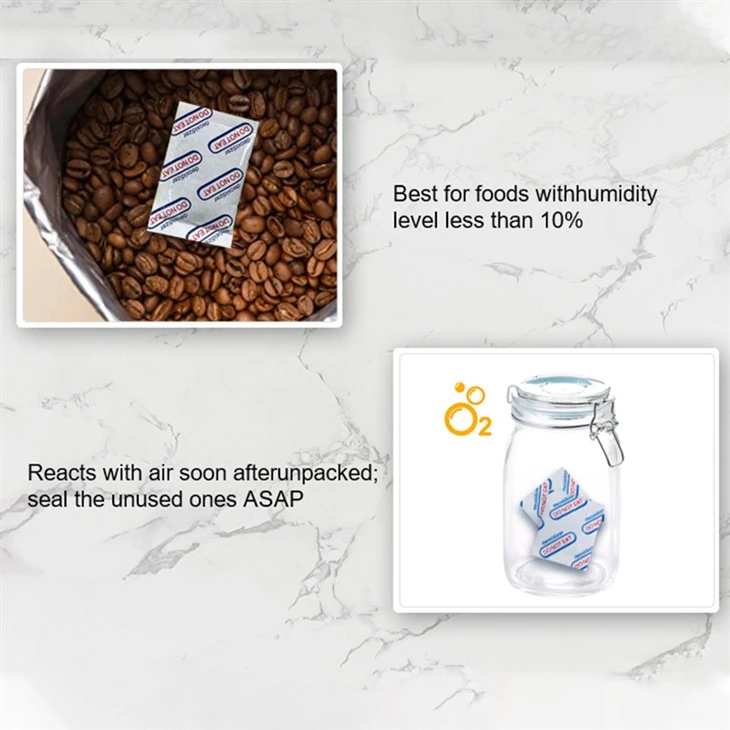
First off, what the heck is an oxygen scavenger? Well, simply put, it's a substance that's designed to absorb or react with oxygen in a closed environment. This helps in preventing oxidation, which can lead to all sorts of problems like food spoilage, rusting of metals, and degradation of various products.
You might be thinking, "Why do we even need to worry about oxygen? It's everywhere!" And you're right, oxygen is a crucial part of our lives. But in certain situations, like when storing food or protecting sensitive equipment, too much oxygen can be a real pain. That's where oxygen scavengers come in handy.

Now, let's talk about low - temperature environments. These can range from your home fridge to industrial cold storage facilities. In these places, the temperature is usually below room temperature, and this can have a significant impact on how oxygen scavengers work.
One of the main ways oxygen scavengers operate is through a chemical reaction. Most common oxygen scavengers are based on iron powder. When iron comes into contact with oxygen and moisture, it undergoes oxidation. The iron reacts with oxygen to form iron oxide (rust), and in the process, it consumes the oxygen in the surrounding environment.
In low - temperature environments, the rate of this chemical reaction slows down. You see, temperature plays a huge role in chemical reactions. According to the Arrhenius equation, the rate constant of a chemical reaction is directly related to temperature. As the temperature drops, the kinetic energy of the molecules involved in the reaction decreases. This means that the iron atoms and oxygen molecules move more slowly, and they are less likely to collide with each other to initiate the oxidation reaction.
However, this doesn't mean that oxygen scavengers stop working in low - temperature settings. They just work at a reduced pace. For example, in a refrigerator set at around 4°C (39°F), an oxygen scavenger might take a bit longer to reduce the oxygen level in a sealed container compared to when it's at room temperature.
Another factor to consider is the moisture content. Moisture is essential for the oxidation reaction of iron - based oxygen scavengers. In low - temperature environments, the relative humidity can be lower. Cold air can hold less moisture than warm air, so there might not be enough water vapor available for the reaction to occur efficiently.
But don't worry, there are ways to deal with these challenges. Some oxygen scavengers are formulated with additives that can help maintain the necessary moisture level even in low - temperature conditions. These additives can act as a source of water or help in retaining the existing moisture in the vicinity of the scavenger.
Now, let's look at the different types of oxygen scavengers and how they perform in low - temperature environments.
Iron - based oxygen scavengers
As I mentioned earlier, iron - based scavengers are the most common type. They are cost - effective and widely used in food packaging. In low - temperature environments, their performance is affected by the reduced reaction rate and potential lack of moisture. However, they can still do the job if given enough time. For example, in a food storage container in a fridge, they can gradually reduce the oxygen level over a few days, which helps in keeping the food fresh for longer. You can check out our Oxygen Absorbers for Food Storage for more information on how these work in food - related applications.
Sulfite - based oxygen scavengers
Sulfite - based scavengers work by reacting with oxygen to form sulfate. They are often used in water treatment and some industrial applications. In low - temperature environments, their reaction rate also slows down. But they have an advantage over iron - based scavengers in some cases. Sulfite - based scavengers can work in more alkaline conditions, and they might be less affected by the moisture level compared to iron - based ones.
Enzyme - based oxygen scavengers
Enzyme - based oxygen scavengers use enzymes to catalyze the reaction with oxygen. These are more sensitive to temperature changes. Enzymes have an optimal temperature range at which they work best. In low - temperature environments, the enzymes become less active, and the scavenging process slows down significantly. However, they are very specific in their action and can be used in applications where a more targeted oxygen removal is required.
So, how can you make the most of oxygen scavengers in low - temperature environments?
First, choose the right type of scavenger for your application. If you're storing food in a fridge, an iron - based Absorbent Oxygens Pack might be a good choice. If you're dealing with a water - based system in a cold environment, a sulfite - based scavenger could be more suitable.
Second, consider the size of the scavenger. In low - temperature conditions, since the reaction rate is slower, you might need to use a larger quantity of scavenger to achieve the desired oxygen reduction in a reasonable time frame.
Third, ensure that there is some moisture present. You can add a small amount of water or use a scavenger with built - in moisture - retaining additives.
Now, if you're in the market for high - quality oxygen scavengers, whether for low - temperature or normal environments, we've got you covered. Our Oxygen Scavenger products are carefully formulated to provide efficient oxygen removal. We offer a wide range of options to suit different applications and requirements.
If you're interested in learning more about our products or have any questions regarding oxygen scavengers in low - temperature environments, don't hesitate to reach out. We're always happy to have a chat and help you find the best solution for your needs. Whether you're a small business looking to preserve your products or a large - scale industrial operation, we can work together to ensure that your oxygen - related problems are solved.
In conclusion, oxygen scavengers can still work effectively in low - temperature environments, although their performance might be affected. By understanding how they work and taking the right steps, you can make them work for you. So, if you're facing oxygen - related issues in cold settings, give our oxygen scavengers a try. We're confident that you'll see the difference they can make.
References
- Atkins, P., & de Paula, J. (2006). Physical Chemistry. Oxford University Press.
- Brown, T. L., LeMay, H. E., Bursten, B. E., & Murphy, C. J. (2006). Chemistry: The Central Science. Pearson Prentice Hall.


