


Hey there! As a supplier of Clay Desiccant Packs, I often get asked about what goes on inside these little packs when they're out there doing their job of soaking up moisture. So, let's dive right in and break down the chemical reaction that happens during moisture absorption in Clay Desiccant Packs.
First off, what exactly is clay desiccant? Clay desiccant is made from natural clay minerals, usually bentonite clay. It's a super popular choice for keeping things dry because it's affordable, non - toxic, and can absorb a decent amount of moisture. You can find out more about its various uses over at Clay Desiccant Uses.
Now, let's talk about the moisture absorption process. The key to understanding the chemical reaction lies in the structure of the clay. Bentonite clay has a unique layered structure. These layers are made up of tiny platelets that have a negative charge on their surfaces. When water molecules (H₂O) come into contact with the clay, something really interesting happens.
Water is a polar molecule. That means it has a positive end and a negative end. The oxygen atom in the water molecule has a partial negative charge, while the hydrogen atoms have partial positive charges. Due to these charges, water molecules are attracted to the negatively charged surfaces of the clay platelets. This attraction is called an electrostatic force.
The water molecules start to attach themselves to the clay platelets through a process called adsorption. Adsorption is different from absorption. In absorption, a substance is taken inside another substance. But in adsorption, molecules are attracted and held on the surface of a material.
The chemical reaction can be thought of as a physical - chemical interaction. There isn't a new compound formed in the traditional sense of a chemical reaction where bonds are broken and new ones are made. Instead, the water molecules are held on the surface of the clay by intermolecular forces.
Let's break it down a bit more. The clay's surface has a lot of pores and channels. These pores act like little traps for the water molecules. As the water molecules enter these pores, they get stuck there. The more water there is in the air, the more water molecules are available to be adsorbed by the clay.
The amount of water that clay desiccant can adsorb depends on a few factors. One of the main factors is the relative humidity of the environment. Relative humidity is the amount of water vapor in the air compared to the maximum amount of water vapor the air can hold at a given temperature. The higher the relative humidity, the more water the clay desiccant can adsorb.
Another factor is the temperature. Generally, as the temperature increases, the clay desiccant becomes less effective at adsorbing water. This is because at higher temperatures, the water molecules have more energy and are less likely to stick to the clay surface.
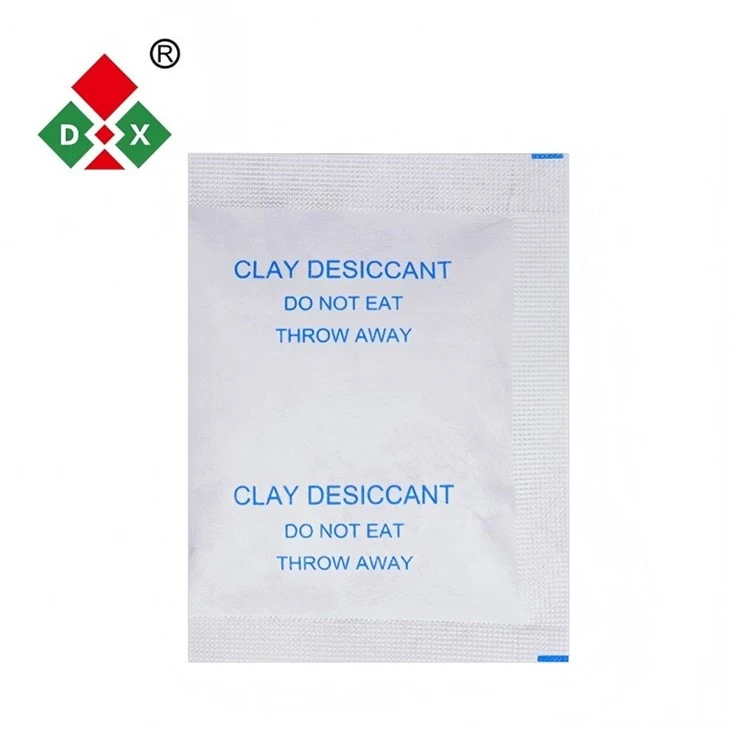
Now, let's talk about how this all relates to our Clay Desiccant Packs. These packs are designed to be convenient and easy to use. The clay is packed inside a breathable material, like a non - woven fabric. This allows the air to pass through the pack and reach the clay, so the moisture can be adsorbed.
Once the clay desiccant has adsorbed a certain amount of water, it reaches its saturation point. At this point, it can't adsorb any more water. You can tell if a clay desiccant pack is saturated if it feels heavy or if you notice that the environment it's in isn't as dry as it should be.

One of the great things about clay desiccant is that it can be regenerated. If you heat the saturated clay desiccant to a certain temperature, the water molecules that are adsorbed on the surface of the clay will gain enough energy to break free from the intermolecular forces holding them there. Once the water is removed, the clay desiccant can be used again.
Clay desiccant packs are used in a wide variety of applications. They're commonly used in shipping containers to prevent moisture damage to goods during transit. If you've ever received a package and found a little clay desiccant bag inside, that's to keep your item dry. You can learn more about these Clay Desiccant Bag and their uses.
They're also used in warehouses to protect stored goods from humidity. In the electronics industry, clay desiccant packs are used to keep sensitive electronic components dry. Moisture can cause corrosion and other damage to electronics, so keeping them dry is crucial.
In the food industry, clay desiccant packs are used to keep food products fresh. They prevent the growth of mold and bacteria that thrive in moist environments.
As a supplier of Clay Desiccant Packs, I can tell you that we take a lot of care in making sure our products are of the highest quality. We test our clay desiccant to ensure that it can adsorb the right amount of moisture and that it meets all the necessary safety standards.
If you're in need of Clay Desiccant Packs for your business, whether it's for shipping, storage, or any other application, we'd love to have a chat. We can provide you with the right quantity and the best solution for your specific needs. Don't hesitate to reach out and start a conversation about your requirements. We're here to help you keep your products dry and protected.
In conclusion, the chemical reaction in Clay Desiccant Packs during moisture absorption is a fascinating process. It's a combination of physical and chemical interactions that allow the clay to effectively adsorb water molecules from the air. Understanding this process can help you make the most of these desiccant packs and ensure that your products stay dry and in good condition.
References:
- Textbooks on physical chemistry, which cover topics on adsorption and intermolecular forces.
- Industry reports on desiccant materials and their applications.


