Hey there! As a supplier of clay desiccants, I often get asked about what's actually in these little packets that do such a great job of keeping things dry. So, let's dive right into the chemical composition of clay desiccant.
Clay desiccants are pretty cool because they're made from natural materials. The main ingredient in most clay desiccants is bentonite clay. Bentonite is a type of clay that forms from the weathering of volcanic ash. It's super absorbent, which is why it's perfect for making desiccants.
The chemical composition of bentonite clay is mainly composed of montmorillonite, a type of phyllosilicate mineral. Montmorillonite has a unique crystal structure. It's made up of layers of silicate sheets, and between these layers, there's space that can trap water molecules. This is the key to the desiccant's moisture - absorbing ability.
The chemical formula of montmorillonite can be written in a simplified form as (Na,Ca)0.33(Al,Mg)2(Si4O10)(OH)2·nH2O. In this formula, the (Na,Ca) part represents the exchangeable cations. Sodium (Na) and calcium (Ca) ions can be exchanged with other ions in the environment. The (Al,Mg) indicates that aluminum (Al) and magnesium (Mg) are present in the structure, and they can substitute for each other to some extent. The (Si4O10) is the silicate part of the structure, which forms the sheets, and (OH)2 represents the hydroxyl groups. The ·nH2O at the end shows that there are water molecules associated with the structure, and the value of n can vary depending on the moisture content.
Apart from montmorillonite, bentonite clay also contains other minor minerals and elements. There might be some quartz (SiO2), which is a very common mineral found in many rocks and soils. Quartz is relatively inert and doesn't contribute much to the moisture - absorbing properties of the desiccant. There could also be small amounts of feldspar, which is a group of aluminosilicate minerals. Feldspar has the general formula KAlSi3O8 - NaAlSi3O8 - CaAl2Si2O8.
The presence of these minor minerals and elements can vary depending on the source of the bentonite clay. Different deposits of bentonite around the world have slightly different compositions because of the varying geological conditions under which they were formed.
Now, let's talk about how this chemical composition translates into the performance of clay desiccants. The montmorillonite in the bentonite clay has a high surface area. When you have a high surface area, there are more places for water molecules to attach. The water molecules are attracted to the charged sites on the surface of the montmorillonite layers. The exchangeable cations like sodium and calcium also play a role. They can interact with water molecules through ion - dipole interactions, helping to hold the water in the structure.
As the clay desiccant absorbs moisture, the water molecules are trapped between the layers of the montmorillonite. This process is called adsorption. It's different from absorption, where a substance takes in another substance throughout its volume. In adsorption, the water molecules stick to the surface of the desiccant.
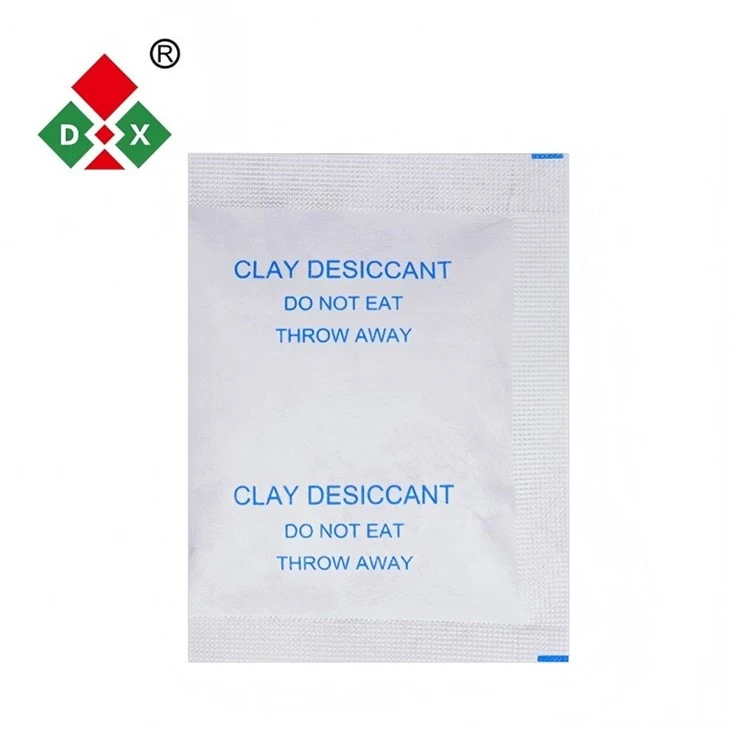

One of the great things about clay desiccants is that they're environmentally friendly. Since they're made from natural clay, they're non - toxic and biodegradable. This makes them a popular choice for many applications, especially in the food and pharmaceutical industries.
If you're in the market for clay desiccants, we've got a great range of products. Check out our Clay Desiccant Packs and Clay Desiccant Bag. These are designed to meet different needs, whether you're looking to protect small items or larger shipments. And if you're specifically interested in bentonite - based desiccants, our Bentonite Clay Desiccant is a top - notch option.
We're always here to help you find the right desiccant solution for your business. Whether you're a small - scale operation or a large corporation, we can provide you with the right quantity and type of clay desiccant. If you have any questions about our products, their chemical composition, or how they work in your specific application, don't hesitate to reach out. We can have a detailed discussion about your requirements and come up with a customized solution.
In conclusion, the chemical composition of clay desiccant, mainly centered around bentonite clay with its montmorillonite content, gives it excellent moisture - absorbing properties. The unique structure of montmorillonite allows it to trap water molecules effectively, making it a reliable choice for keeping your products dry. So, if you're looking for a natural, effective, and environmentally friendly desiccant, clay desiccants are the way to go.
References
- Deer, W. A., Howie, R. A., & Zussman, J. (1992). Rock - forming minerals: Vol. 3A, Single - chain silicates. Longman Scientific & Technical.
- Grim, R. E. (1968). Clay mineralogy. McGraw - Hill.